SAGAMI BAY, Japan — Japan and the United States staged a naval show of strength off Tokyo Bay on Sunday as they flashed a pair of powerful, flat-deck warships perhaps just days before the U.S. Navy plans to challenge disputed Chinese claims to territory in the nearby South China Sea .
The aircraft carrier USS Ronald Reagan and the JS Izumo , the largest warship Japan has built since World War II , highlighted a seagoing review by Japan’s Maritime Self Defense Force that included 36 warships and dozens of military aircraft.
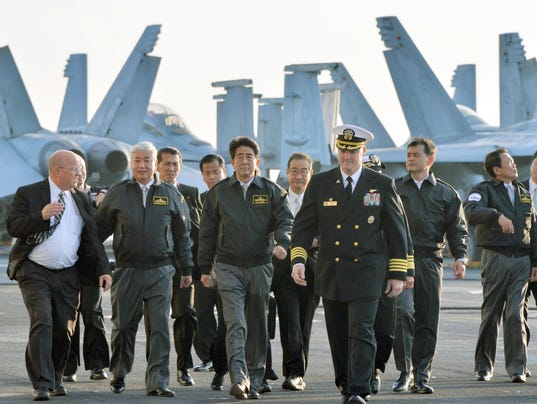
Shortly after the ceremony, Prime Minister Shinzo Abe became the first serving Japanese leader to board a U.S. aircraft carrier when he flew to the Ronald Reagan by helicopter.
Although the Japanese fleet review is held every three years, it held added significance this year because of mounting tensions over artificial islands China has built in the South China Sea, as well as new defense legislation in Japan that eases decades-long restrictions on Japan’s military.
The Ronald Reagan arrived this month at its new homeport in Yokosuka, Japan . The ship recently completed a year-long modernization program and is considered one of the most powerful ships in the U.S. Navy. Its recent transfer to Japan is part of the U.S. “rebalance” to focus more on Asia.
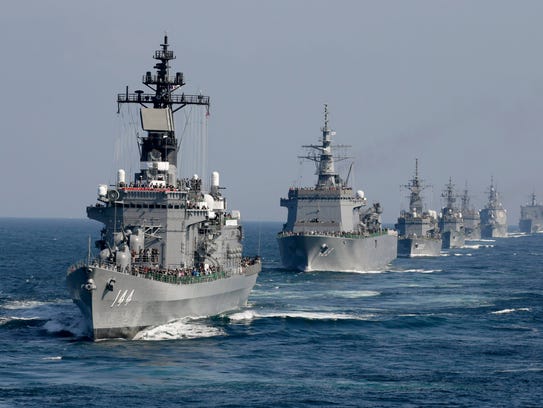
The Izumo was commissioned this year. Although designed primarily to host helicopters for anti-submarine warfare and other duties, the Izumo’s long flat deck and overall design have led many to believe that Japan eventually could use the ship to carry fixed-wing aircraft.
Japanese officials have emphatically denied that.
Nonetheless, Abe last month succeeded in a long-sought goal to allow Japan’s military — including its maritime self-defense force — to aid U.S. or friendly forces when they come under attack. That previously was forbidden under Japan’s pacifist Constitution.
Japan currently is embroiled in a tense dispute with China over ownership of a tiny group of islands in the East China Sea . And Abe has supported U.S. demands that China halt its island-building program in the South China Sea.
U.S. officials have said in recent weeks that they plan to send U.S. warships within the presumed 12-mile territorial limit around the new islands. The patrols would be intended to demonstrate U.S. commitment to “freedom of navigation” in the region.